Showing posts with label self help. Show all posts

Thursday, March 24, 2016

Embarrassing or Empowering: Choice is Yours to Speak Out and Recover


Lately, I have been talking to a lot to people about my book Love on the Line, How to Recover from Romance Scams Gracefully and without Victimisation, It has been a huge learning curve for me about how to best advocate to my audience the importance of recovery as a surviving method from romance scams. My method has been writing through healing narrative. I have been surprised to find how hard the recovery really is because so many people feel embarrassed by their own experience. 

There are many reasons for embarrassment from loosing money to not really believing that such a thing could happen to me. Sometimes it is hard to face yourself and admit to the vulnerability that is within everyone of us. Sometimes it is hard to be confident to know that it was never your fault, even though the victims are often blamed for the crime, What is certain is that anyone can become a target of a scammer. Dr Cassandra Cross from the Queensland University of Technology, while talking at my book launch in January 2016, put it as it is:

   "The reality is that anyone could become a victim of scammers. We all have vulnerability. We have to respect that the offenders know exactly how to find that vulnerability and weakness. That is their profession."

She also said that people like me who come forward and speak out are rare. I was not really aware how rare, before I started to really engage with my readers and interested audience. I also found that many websites or groups that take on the issue of scamming have to work in secrecy or very privately to keep their members protected from treats. It was a schock to understand how many people are affected by scamming.

Wouldn't it be the ideal that our world would support the victims of scams. Instead, many feel isolated and afraid. Many feel devastated and disillusioned with the world. Luckily, there is hope, healing and recovery to consider. There are those who have spoken out about it, like Sharron Armstrong with her #standup2scams community. There are people like John with his Website and Facebook group who want to help. There are bloggers like Jas who write about inequality and how to engage yourself in making the world a better place, Last, but not least, there e people like Chris and Glenda who have made it their primary purpose to help others, in business and in person to get over it and act on it. I feel it my duty to spread the word of hope and positivity through writing.

So, join me in empowering yourself by using hashtags like #stanup2scams and my new one #speakoutandheal in your social media postings. Also tags like #empowerment #endviolence #positiveaction and #recoveryispossible would be good. And you can make up your own as you go. Blogging is also an effective and easy way to get your meaning accross to a wider audience. Sometimes, there might not be a huge readership, at first but we are working towards a long time result so every little action is a welcome addition to the movement. And if you have some good ones, please feel free to comment and and suggest down below, 

I am currently developing writing workshops and also a newsletter. My new Website for Love on the Line Book is alive and there is a blog that is all about those important question that has come fort during my book signing and event tours. Feel free to get involved. My main Website should get you everywhere. The book can be bought through Xlibris or any other main distributor like Amazon. Ah, and do like my Facebook Author page, too.

I wish you all a great Holiday Break from Australia.


Sunday, October 11, 2015

Has Fraud Touched Your Life: Sharon Armstrong in Conversation at the QLD Fraud Support & Recovery Group


It is an alarmingly ever rising number of people that are touched by fraud in its different forms. Many have a personal experience with scammers, and others know someone from their family, friends and acquaintances who have been victims of fraud. It is a devastating experience and many do not recover or it takes years of great effort and strength to move on in life.

Meet Sharon Armstrong, a very courageous woman, who was scammed into unknowingly carrying drugs for her scammer. She was arrested and spent two and half years in an Argentinian prison for a crime she was scammed to commit. Should she have known better?

After all she is an intelligent woman. She had previously held a high position in the New Zealand Public Service and had not for twenty years had time to think about dating with her busy life. This had been her own choice. Somehow, though, she suddenly fell for a charming man at the other end of the line and was convinced that it was her destiny to marry and spend the rest of her life together with this same man. For the sake of their future, she was ready to help him with money and later by picking up some papers and carrying them to London, where she would meet him. But this did not happen. Instead she was stopped by the customs in Argentina. She was told that she was carrying cocaine and that she would be arrested. Later she was sentenced and in the end spent two and half years of her life in the prison surrounded by other 'drug mules'. What was it that made her so vulnerable to scammers?

I am really interested in her story. It is yet another version of the Ghana scam, like mine was as well. It adds another more frightening, if not deadly dimension into the life of a victim of a scam. She talks about vulnerability but adds that maybe even saying that makes the person more vulnerable. And vulnerable people get caught in scams again and again. She prefers the term survivor just as I do. She is not sure that she has recovered, though. What is it that keeps the victims attached, I would ask.

An other woman who is listening to Sharon thinks that she would be too sceptical and this kind of romance scam just wouldn't happen to her. I doubt her statement. Media, who was very hash in the case of Sharon declared that of course it could happen to her; what else could she expect, because 'she is fat and plain'. I strongly disagree. And she is not that. Clearly she is attractive, intelligent and strong, otherwise she would not be putting herself forwards again and sharing her experience in order to educate and raise awareness for fraud and especially for the different forms of romance scams.

My research, packed by others shows that no, she could not have known better. There is no clear profile of a person who would fall for a romance scam. Everyone is a potential prospect. It is all in the scammers ability to catch the target at the right time and persuade her/his brain to act with the emotional 'lizard brain' instead of the rational frontal cortex. The experience of the continuous flooding of oxytocin to the brain keeps us attached and falling yet again and again. Sharon confirms this when asked about how she did go from loss to recovery. Her answer is that it was easier for her because she was 'locked up'. Otherwise, she says, 'it would have been hard for her to keep away from this man'. But what is it that contributed to her personal recovery when so many affected people cannot make the transition from a victim mode to the survivor strength?

Sharon Armstrong sits up and looks at the audience with confidence and lists her reasons:
- always having a positive outlook
- thinking and seeing that others had it tougher than her
- learning to appreciate little things
- learning to forgive
- her family's continuous and unwavering support

Her wisdom is profound. She states that forgiveness is not about others. It is about you. And learning to be grateful is a way to recovery. It is important to share your experience in order to fight the scams, to raise awareness. 'We must stop the shame', she says. I fully agree. It is crucial that there are people, just like Sharon who are willing to personally step into limelight to make the fight visible.

Sharon has started a campaign. It is called Standup2scams. It is everywhere on the social media but mostly on the Facebook and the Twitter. You can easily find it there. She has also recently been part of a two part documentary. It can be found through her pages as well. I am looking forwards to her new projects.

There is a book on the line in near future and also a possible documentary project. So there is much to come from her experience that will change your knowledgebase about romance scams and fraud.

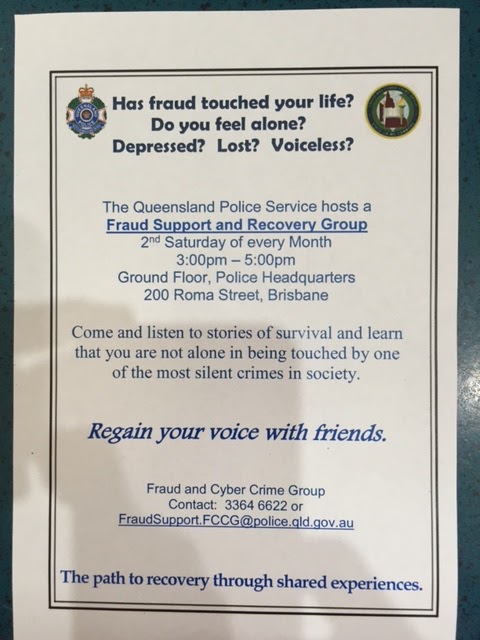
Otherwise if you need help right now, please be aware that there is a QLD Police Fraud Support & Recovery group meeting every month. And similar groups are being planned and founded elsewhere as well. Here is a flyer for that:


Tuesday, January 1, 2013

Contemplation on New Years Resolutions for 2013


So, it is the New Year and time for new resolutions. Usually, according to statistics from the Australian TV program The Project (01/01/13) by the end of the first month of the year 25% of the promises we have made to ourselves have been broken and during the second month the non-action escalates to 46% of resolutions not being attended to. What kind of conclusion should we draw from that?

The Project concluded tongue in cheek that the resolutions were made by people who were mostly dunk and who cares for the promises made while being affected by alcohol anyway! I feel though that the data shows the volatility of people in general. Our promises are often made while 'crossing the fingers' behind our backs. New Year's Resolutions are often made just because it is part of the celebration tradition and not because people seriously think of commitment. Inspiring? Not in the least.

However, this year I was inspired by finding my hidden practical abilities instead of making promises I wouldn't keep. I am figuring that by appreciating what I find I didn't know or remember I can do, I could commit my abilities to refocusing in committing to my already so many times thought over and voiced New Years Resolutions. No need to make so many new ones. I already had made them ten times before so they must be good and important.


I found that I can for example read 'complicated' IKEA furniture assembly instructions and by following the steps, I can put together any number of pieces of furniture, like sofas, TV stands and most importantly bed frames all on my own. Surely some sweat and some mishaps have gone into the project but mostly the results have given me a huge boost of confidence in myself and my abilities to do whatever I want to accomplish.
Taking the cue from what I have now learned about me, I find myself more confident in writing down my annual list of what I want for the new year.


Here is an example of how to do an action plan for 2013 New Years Resolution list:

First evaluate the last year's resolutions. Hopefully they were written down for evidence based data collection.
I prefer to have them under four categories: Emotional, Mental, Financial and Physical.
It is surprising how many items can be ticked off from the list.

Secondly, think how you really want your life to be a year from now. Even write a letter for yourself dated on the next New Year of the gone year. Then break the resolutions to smaller actionable bits.

Thirdly, make a monthly/weekly action plan depending on the suitability of the resolution. Some resolutions are statements of intentions on where you want your life path to lead.

Fourthly, and most importantly believe in your own ability to commit to the plan. It only takes four weeks to develop it into a habit.

Have a great New Year and enjoy your new found happiness in yourself.

- Posted using BlogPress from my iPad