Showing posts with label compassion. Show all posts

Monday, February 6, 2017

How to Get Educated about Internet Fraud?


Going back one year of my life and it feels like a lot has changed. My book Love on the Line. How to Recover from Romance Scams Gracefully and without Victimisation was just published and here we stood, my friends Chris, Fiona and I posing with the new printed information. It was the definite start to my education on romance fraud, scamming and people who have been affected by this ever increasing global crime scene.

I definitely loved the colour of my book, pink. Little did I know that one year from the publication of my book, fusain pink would be a new colour of the women activism of the world. Cheers for that! I am just about to knit my own hat. I feel this year I need one to upgrade my efforts to educate people about internet fraud and activism. For me, last year on the road, talking at 20 events, mostly libraries was an eye opener. And I started writing my second book as well. It will be about empowerment after surviving fraud.

For me, it is important to continue the recovery from the traumatic experience and why? Because, it will never go away! It will always be there as an experience, nagging me to awareness. In one year, I have gone through such a learning curve that I never thought possible. I have totally re-evaluated my whole life from start to finish, from birth to this present moment in time, in relation to my experience as a survivor of Internet fraud.

It has made me stronger. It has given me a new purpose. It has reconnected me with my own sources of strength. This years theme for the Women's Day #BeBoldForChange truly applies to me. This year I have elevated from humbly starting to call myself an author, to Author, Speaker and Professional Anti-Scamming Activist. How great is that! You can see the upgrade on my Website. I feel so proud. I am proud of myself, proud of all the people, friends, family and supporting networks that have contributed to my change. It has been profound.

Yesterday, I was excited about my new ventures. Soon I will be going to Europe: Finland, Sweden and the UK. I cannot wait to talk about my book, and how to avoid Internet fraud and start the process of recovery and continue with the process of empowerment from thereafter.
Here is a cheer to my new challenges, to my new adventures. I will report back. For now I am just so grateful. I recommend: get on with the program and get educated, buy a copy of my book, for example, Read it to start with your own journey to recovery and further to empowerment and to a great life that is void of fraud, Become observant and aware of the hazards of the modern digital world. Be safe. Be an activist. Have a life.


Sunday, December 4, 2016

How Long Does the Santa Claus Live?


Santa Claus or Joulupukki as I know him in my own Finnish language has been a continuing presence in my life since my birth during the 1950s in Lapland, Finland. I am a Christmas child myself who was born in a city that resides both the Santa Claus’ Main Post Office at Napapiiri at the Arctic Circle and the long tradition of tourist industry around Santa/Julupukki, including the official University courses in Elf Profession. Just check here to believe it. I am not telling you fibs.

Once in a while, or quite often actually, researchers do tell you that Santa is a lie, check in here and if you still have doubts here it is in Finnish. Every now and then we are also reminded that adults think too much. I mean in no respect to demean the two articles presented here but I am convinced that whatever we believe does construct our reality, including the metaphysical reality of Santa. Check my previous 2010 posting here about what is the history of the Santa tradition I believe in.
This year, like every year, it has come to pass that people are considering Santa and their Christmas traditions, including its political correctness and the commercialisation surrounding the modern practice of giving enormous amounts of presents to everyone. It boosts the economy, say the economists and many, if not all the shops rely on their Christmas sales to cover much of their yearly expenses. This makes it understandable that we keep on staring the Christmas markets earlier and earlier in the year. And who wouldn’t like to boost the economy? Or maybe not.


I live in Australia and find that the Christmas for me starts with the decorations at the shopping center, because otherwise, it is summer. The season comes as a great contradiction to my birth home of Rovaniemi, where the winter snow falls plentiful and it is freezing cold. In Australia, in the heat and the sun, it is quite hard for me to think about Christmas in the way I used to as a child. Now my traditions much come from having fun with the grandchildren and imagining with them how Santa would ride the skis from Lapland to deliver the presents Downunder.

My grandchildren know very well, where the line of the fairy-tale and the reality lies. They think that it is ‘cool’ that they, for example, know exactly where the North Pole is: that it is at Rovaniemi, Finland. And why do they know is because they have been there themselves. My six-year old granddaughter insists on this. “Mummu, I have actually been there twice.” There is no buts about it. She does not think about it philosophically, or in any metaphorical way. For her North Pole is where the Santa lives and because she knows the Santa, Rovaniemi for her is the North Pole. It is possible for children to think about Santa philosophically as well. At the age of five, my elder son asked me how long I thought Santa would live and when I answered: “As long as you believe in him”, he immediately said: “Oh, just like God!” That was also clear at one go and the end of the discussion.

Oh no, my granddaughter thinks about it all as a great potential for performance. She needs the right costume, and the right music and the right atmosphere and we are on. This will be the best Christmas ever performed. I bet it will include the music from the movie Trolls as for her it is the best dancing soundtrack possible to imagine.
The other way, I get my Christmas spirit rising is through technology and internet. I plan on talking to my family situated around the world, especially the other granddaughter in London. We are planning on maybe decorating our Christmas trees together, at the same time, through connecting on Skype. At least we will build Lego Christmas decorations together in our weekly get-togethers. We will show and tell about all the little decorations I have collected and placed in our tree. They come with different memories of my family for generations. Before this tree decorating used to be on the 13th of December, because the Saint Lucia’s Day was my mother’s day. The family tradition carried to us from Sweden through the WWII when my mother was a refugee as a child there. We remember, I can tell it all to my grandchildren in my mother tongue, in Finnish.
This year, though, like last year, my grandchildren are in a hurry, and so am I. So, we might decorate the tree during the first week of December, already. The artificial trees that last and last make this longer season possible. The positive part is that we can even choose the colour of the tree as we fancy. This year it will be black. And from there on, sitting quietly, watching the lights on that tree reminds me of the Christmases past, present and the future. Baking cookies and the Karelian Pies with kids makes my Christmas real.
Our Christmas or Yule/Joulu traditions as I say it in Finnish might change and adjust into new technology, new environments and blend with new traditions. Still, for us the message of Santa remains the same: compassion, kindness, light, fun and caring. To me, it is no lie, it is a reality worth sharing with my family and friends and passing on to children and grandchildren.
If the spirit of Santa grows into a figure of a jolly old man or a strong grandma like woman, it might not be so bad to imagine that it is the spirit of the ages, all the good parts from Odin to St Nicolaus and many other unimaginable realities blended together into a consideration of others and their plight. It is not always about us. Mostly it is about the truth. So, how long does the Santa live? I still say that wherever or whenever you are, it depends on your own capability to imagine.

Saturday, November 26, 2011

Amongst the Childhood Memories; Christmas Characters Re-visited


Christmas is fast approaching. It is clearly evident that the shopping centers are starting to prepare earlier and at the same time people are too busy to notice and start thinking about it later and later. This is just the best time for the storybook characters to appear in their fancy best.

So, I found this Facebook page called 'Make your profile picture your favorite character until Christmas' and I 'liked' it. It was actually for the last year but who cares. This is cool, I thought and the next thing would be actually to do it. The picture attached to this posting shows where I have come to. My choice for this year will be the White Rabbit dressed as a Christmas character. I actually met him at the local shopping centre and was able to be photographed with him.

Steps to take when choosing your favorite profile character until this Christmas

1. Overall attitude

The first step is to decide if you like a traditional or recently created popular character as a favorite. Are you a traditionalist or a modernist? In the world of possible characters it makes a big difference.


Traditional characters for Christmas time would enhance the compassionate attitude of the season. Then you could also go for the quirky, or you could go for the elves. That would be enhancing the fun of the season. There is also the 'creepy' way.

My choice of the White Rabbit dressed as a Christmas character is somewhere between, a traditional storybook character with a quirky look about him. Mr Carroll could approve that, I think.

2. Following the times or maybe not

Step two is deciding do you what to follow the times or do you want to keep to the old look.

Sitting in a cafe at my local shopping centre observing this year's children's storybook parade I noticed that the characters walk much quicker than before.

The Loony Toons characters that marched past us were very agile. They are also taller and more streamlined and they have long skinny legs. No wonder that they can dance and sing and jump around the stage like anything. The other storybook characters were clearly influenced by Dr Zeuss characters or by the latest Christmas films.

The most alarming observation in my mind was that the Mother Santa and all her elves were so small and skinny. She wore high heals to boot. OMG, I say. They were cute, though. The tiny elves with skinny, skinny legs all dressed in green and red. On the positive side, the number of the little elves has grown. Instead of one round Santa and an elf, there are huddles of them all around the shopping place, including the Cat in the Hat and the Chrich.

Going with the flow is my choice. It allows for full enjoyment of all the new that has been created and lets you be inspired by the moment. If the old is reinvented, all the best for that, too.

3. Being charmed or not

The third step is to decide if you will be charmed or not by this new development.

So, I chose to be charmed by the crowds of tiny Helpers and Storybook Characters. For my favorite character I had three contestants, namely the Moomin Mother, Mad Hatter and the White  Rabbit.                                      


It was a tough choice until I met the White Rabbit in person. This is a point for direct marketing, I was immediately persuaded.

Merry Christmas Season to Everyone! Let's be compassionate in small things as well as the big ones this year!
- Posted using BlogPress from my iPad

Saturday, October 29, 2011

Be Inspired by Everything


At this time of the year in Australia, I am really inspired by the colours of the spring. They are everywhere. Everything seems to bloom. And still, after so many years of living in Queensland and experiencing it, I get inspired by the idea that long time ago some forward thinking people planted flowering trees around the place in rows so that other people would be able to enjoy and be inspired by them in their unforeseen future. I also get inspired by the fact that everything that in my birth country is grown inside in pots here grows into trees and flowers as well.

I get inspired by little things. People who smile and say hello even though they do not know you. They are in the act of spreading goodwill and sharing their positivity. It is invigorating.

I get inspired by art, music and culture. Listening to inspirational music lifts your spirits spreading calmness and good feelings. it contributes to making your day better.
                                    
I get inspired by exhibitions and museums where people have collected inspiring things or ideas. Even after experiencing the Queensland Museum many times, I still think it is cool that the sex of a sea turtle is determined by the temperature of the eggs.

Most of all I get inspired by other people being inspired. The look of rapture, passion and enthusiasm when they talk about things that inspire them. It can be anything.

Recently, I was inspired by Yvette Adams at the Westside Business Women's breakfast. She inspired us by likening marketing to eating ice-cream. I can just see the visual image of a child enjoying the ice-cream and this inspires me further to try everything she suggested we try on the net.

Just couple days ago, I was inspired by a conversation about light bulbs. It is incredible how the technology and science of producing electricity has changed in the recent times. It is inspiring to understand that the little halogen light that previously did not light much has become so powerful as a light source that it can now light a whole stage.

Last night, I was inspired by the calming music at a friend's house. Listening to the clever piano player being inspired by a long passed composer made my day.

Today, I am looking forward to much more inspiration. My eyes will see things, my primary visual cortex will transport the images to 30 other processing centers of my brain. This process will create meaning for me. My limbic system will recognise the feelings that come to me and I'll be once again inspired by everything I see, do and think.

It is a viscous circle but someone has to be inspired, so why not you and me?

- Posted using BlogPress from my iPad

Saturday, September 24, 2011

Contemplating How to Build Strong Partnerships in the Community; Caddies and the James Homes Services organised the James Family Fun Day at Jimboomba Park

A few months ago two people representing the James Family Home Services came to my office. Their intention was to organise a Family Fun Day for the community and at the same time fundraise for our Community Care organisation. 
As a community organisation we would reap the benefits of this collaboration and together we could involve many members of our community in compassionate voluntary action in helping others.  This collaboration proved to be a real boost for building lasting relationships between local businesses and the Caddies Community Care Centre in Jimboomba. 
Organising the Fun Day itself was a huge challenge and the first attempt was cancelled due to weather. However, everyone was determined and the second planned day was a success.
Analysing the community partnership model
After taking part on many workshops on partnership building, attending relevant interagency meetings, local groups, committees and associations that enhance partnership building between the business community and the local nonprofit community organisations, I am left to thinking on what kind of community partnerships would be ideal in creating such a compassionate atmosphere that it would lead to businesses becoming active in voluntary engagement in the local community? 
My experience is that when I am attending meetings that bring together local businesses, such as The Chamber of Commerce or other associations enhancing business networking, everyone will mention their desire to be involved in the community.  The consensus is there. Everyone is interested and basically ready to get involved. How then can this desire be transformed into real action and support?
The Ideal components of local community action initiative
The first component is the human potential. Ideally the business owner is engaged in community participation. I find many women and men who have built a small business very willing to give back to the community in some easy and convenient way.
The second component is convenience. Community engagement must be inbuilt into the business structure. If a business owner is overworked and just involved in making ends meet, who has time for community involvement?  It is a fact that strategic involvement in the community brings in more business.  How, then, can we find a convenient form of partnering for the local community organisation and the local small businesses?
The third component is access to an agreeable community organisation as a partnering platform. This falls on the community organisations willingness to be accessible and involved in the local community social capacity building. Very often it is the struggle to grow and maintain the high quality service standards that prove to be the biggest challenge. Building partnerships with local businesses just is not in the agenda.
What about the image building
Ideally a local community organisation that is accessible to everyone and involved in helping those who are vulnerable in the community will attest to the values of humanity, impartiality, independence, voluntary service, unity and universality. This means the drive and willingness to include everybody in the community. It also means providing access to everybody without prejudice on the avenue. 
Still being involved with a particular business brand might be considered problematic. On the other hand, it is a normal practice of most of the large charities to partner with big companies to get more fundraising advantages. Just Google on the internet! Local community organisations can partner as well. The question is who would be an ideal partner?
The experience of partnering between JCCA and the James Family Services
In my experience JCCA’s collaboration with the members of the James Home Services proved to be an ideal partnering opportunity. As a nonprofit community care organisation we provide direct services to vulnerable people in the community. We provide aged care, youth and family support and emergency relief to those in need in our community. We also provide food services; food pantry and meals-on-wheels. 
James Home Services similarly provides direct services to clients in their homes, cleaning, lawn mowing and pet grooming. The small family franchises work their business in the community. While our aim is to involve everyone in voluntary service in helping others, they know everyone that could help.
Due to this our collaboration in organising the James Family Fun Day at Jimboomba Park was a success. The active, involved and compassionate people of the James Home Services were able to mobilise their group and other businesses in the day and at the same time fundraise for Caddies. We were able to use our organisational expertise in helping to organise the event, acquire licences and participation.
All in all this proved to be a wonderful start to successful partnering! I am looking forward to more in the future.


Saturday, June 25, 2011

Traveling With Compassion as a Criteria


Many people choose to travel the world in pursuit of great and famous sites and sights. I am much like that, also. But lately just traveling and sightseeing has not really been so attractive to me any more. What I want to do is to be challenged by what I see. I want to be immersed and fully participating in my travels. Otherwise, I feel the time is wasted.

I want to be able to tell a great compassion in action story. I want to be able to see something that really makes me think about what is special about the site where I visit. I also like to ponder about what it represents or how it relates to the transformation of human consciousness.

Many recommended famous places that are perused by visitors in thousands are great historical monuments dedicated to wars, fame and money. Generally, I am less interested in them.

I want to see the places and monuments that reflect compassionate actions. Something that has or is having a continuous effect in the changing human consciousness.

I am quite happy with small deeds. Lot's of small and less noticeable actions combined can contribute to the wellbeing of the humankind in a big way.

In the theory of apprehensive inquiry and strategic questioning it is determined that the questions have to be set up right to produce the desired results. It is better to start from the positive actions than try to fix the negative behavior. The positive strategic positioning will increase the positive result and outcomes.

My new blog at http://www.thecompassionateworldtraveler.blogspot.com/ is my answer to the quest. It records where I have been searching. In the beginning I will go backward in time to the places I have already visited but will also collect new interesting places or stories in preparation for visiting more places.

I hope this will prove to be an enjoyable journey that will enhance our understanding of compassion in action. Please, check it out and enjoy.

- Posted using BlogPress from my iPad

Tuesday, September 28, 2010

Where do the foundations of charitable and philanthropic thinking processes lie? – Looking for answers though the scientific approach.

Brief reflections and realisations gained at Dr Bruce D. Perry’s seminar on Transforming Childhood Trauma: Connecting with Empathy and Compassion held in Brisbane, 15/09/2010
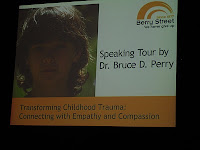
A friend and I shared a very wonderful day at the Brisbane Convention Centre listening to Dr Bruce D. Perry’s insights on childhood trauma and recovery models. The auditorium was full of his fans from far and wide. Dr Perry certainly can take his audience to an exciting trip though the human brain development. The research and the case stories he shared with the spectators were extremely well streamlined within his presentation.

I was immediately captured by his comments on the age old practice of having your child sleeping next to you and his declaration that the modern preference to separate the children from their parents is not respecting the natural children’s brain development which is dependent on the building of a close nurturing relationship between the primary carer and the child. The closer and the more fostering this relationship is the better for the future of the child’s ability to feel empathy and be compassionate towards other human beings. Coming from a culture where this is a widely accepted practice, his declaration felt good to hear.

The other most remarkable comments by Dr Perry were that 65% of all the calories a newborn takes with food are consumed by the brain and a four-year old brain has already created 90% of all its functions, including the primary sense of being.

For me it is interesting to note how the brain works in practice by following my own memories that relate to philanthropic, charitable and humane thinking processes in my own life. It is also fascinating to analyse my own attitudes and through self analysis get to know what determined my world today. I have heard this saying so many times in the context of consideration about the rising consciousness: “if you look at yourself now, you know what you were in the past and if you look at your thoughts today, you know what you’ll be in the future.” These types of comments are often articulated in such discussions that conclude to consider words things. This process is concerned of realising an idea in the material world. The thoughts solidify into words and these words solidify into actions and ultimately may materialise as things.

I have two vivid memories that relate to developing as a humane human being, the other voiced by my own mother, with a long career as a teacher in Lapland, Finland and the other a friend in India, with a long career as a doctor and lately a director of Kristnamurti Educational Centre in Bangalore. Both are concerned in educating children to become compassionate human beings. My mother says that we should be learning to eat with a spoon from an early age and sit up properly on our chair as it is part of our culture. My Indian friend says that the two most useless inventions by humans are the spoon and the chair as when we eat with our fingers, our touch is also stimulated and when we crouch, our posture is kept firm and we keep healthy. Both are occupied and agree in bringing up healthy and able human beings. It is remarkable how human beings can start from two totally opposite directions and be of the same mind on the whole. To me this is a demonstration of how unity can be created from diversity. There is not only one way to do things, but many as long as the goal is agreed upon.

Listening to Dr Bruce Perry, who is an expert in brain plasticity, for a day on childhood trauma and recovery models, helped me to realise that we can also take a scientific approach and use our current knowledge of how the brain develops and functions as a tool to enhance and aid the transformation of the human consciousness.


A few thoughts clearly stood out for me on the day in relation to my search for the philanthropic thinking models:

1. The initial quotation Dr Perry used, from W.R. Inge, namely: “The best time to influence the character of a child is 100 years before they are born.” – This relates to longtime hereditary approach.
2. “Our brain allows us to absorb the accumulated and distilled experience of thousands of previous generations in a single lifetime.”
3. The utmost plasticity of the brain, which allows us to rebuild and re-organise the brainstems, diencephalon, the limbic system and the neocortex of the brain from the basic stems to the more complex systems and the other way around from the cortex to the basics. – This leads to that we can influence the brain in positive ways by providing ‘pattern repetitive inputs’.
4. The utmost co-dependence of the organisation of our brain to the close human relationships we have initially formed or the lack of them – The power of human relationships.
5. “From the neural developmental perspective, we need to be respectful of our biology in the process of inventing our reality.”
6. Being born a human does not ensure that a child has the capacity to care, to share, to listen, to be empathetic and have values or to be compassionate. This develops from being cared for. - “Humans become humane.”
7. Human mind pays more attention to the negative comments than to positive. The negative responses we get from our relationships outnumber the positive by 3:5 – “Everybody needs their rewards bucket filled every day.”

It is very comforting and positive to know that Dr Perry’s ‘Neurosequential Model of Therapeutics’ is producing results in the ‘treatment’ of trauma in children. The knowledge that it is possible to work closely together with the traumatised children and their families by using this model by first mapping and then re-organising the brain that has been maltreated in the past, brings with it new realisations of the possibilities imbedded in the utmost plasticity of the brain. What is incredible is that even though the human beings when creating our world seem to have little respect of our neurobiology and instead mostly work against it, it is never too late to re-organise and re-create our reality to better suit the natural environment.

Thinking of the model and the information I got from the seminar, through the handout reading materials and some additional research I could easily draw a direct line to philanthropic thinking models. The same realisations could be used in determining that people with little empathy or inclination to charitable or philanthropic thinking or action have some trauma to recover from. If we would think that a fully mature humane human being does possess the capacity to be compassionate and empathetic, then there must be a way to re-organise the brain to realise this aim.

Many practices aiming at raising human consciousness that we are accustomed to are based on repetitive impulses, yoga-practice for example and mediation, music and movement, prayer and much of singing, particularly traditional folk singing and dancing, even some traditional ways to create art. These practices have been developed during many centuries. We find them comforting and often revert to them when in need to ‘fill our rewards bucket’. All this practice requires close human interaction and relationships in the community to learn.

Lot of what Dr Perry said during the day is something that I knew before, scattered in little bits of information here and there. There has been much scientific research done on following young children to adulthood and through this it is evident that the brain takes longer to develop to its full mature capacity than thought before. The latest research says that we can only expect a 27-year old brain to be fully mature. Other topical interesting research concerns hypothalamus and its functions in sorting out human emotions and the blends of emotions. Our day with Dr Perry brought this research in sharper focus for me. I am really looking forward to reading his book Born for Love; Why Empathy is Essential and Endangered, written with Maia Szalavitz. The reading material that was handed out has been a great source of information. Lots of it can be found in the Child Trauma Academy Website as well. http://www.childtrauma.org/ It is well recommended.

I greatly appreciate all comments for future development.